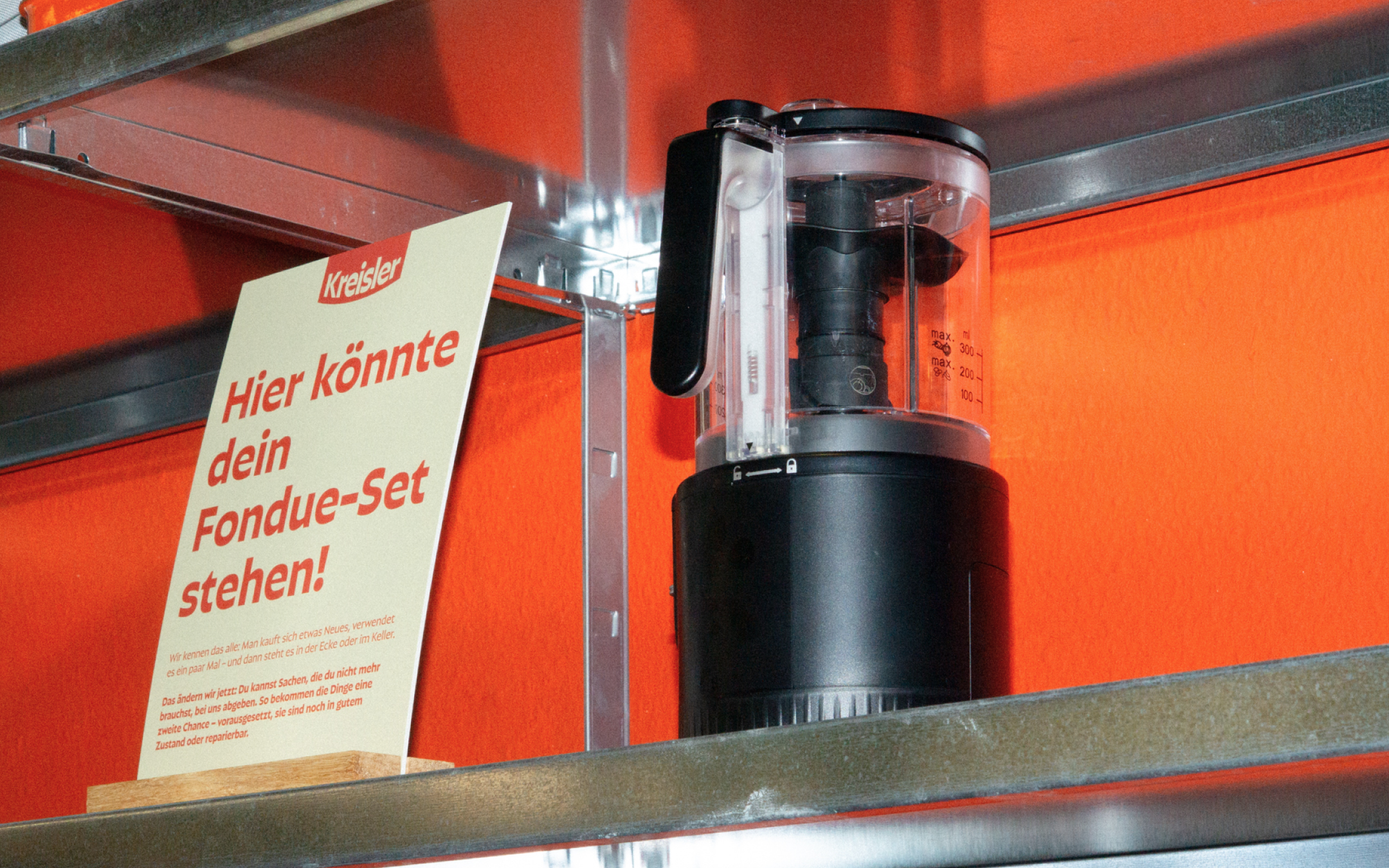
A little more than a year ago, we opened Kreisler in Berlin: a neighbourhood hub for repair, sharing, and circular services. The goal was simple but ambitious—bring circular economy out of theory and into everyday life.
Twelve months later, the most important lesson is surprisingly straightforward: circularity succeeds when it solves real-life problems. Not when it explains sustainability, not when it communicates environmental urgency—but when it becomes the easiest, most useful option for people.
Many sustainability initiatives fail because they speak mainly to the already convinced. They remain inside the ecological bubble. Opening Kreisler forced us to rethink this completely. If circularity is supposed to work at scale, it must be accessible, affordable, understandable and relevant to everyday life.
Accessibility and affordability are not secondary factors. They are the central design criteria for circular systems. When a circular offer is easy to access, saves money, or solves a concrete problem, people will choose it naturally. No persuasion required. Circularity then stops being an environmental decision and becomes the obvious practical choice.
Communication must follow real life
Another major learning concerns communication. Most sustainability communication is too abstract, too complex, and too homogeneous. It assumes knowledge, interest, and language skills that many people simply do not have. Working in a neighbourhood like East Berlin’s Gropiusstadt means facing a very different reality.
People speak lots of different languages. People have different priorities. People have limited time and budgets. So communication needs to adapt. At Kreisler we therefore focused on making communication low-threshold, visual, multilingual and, first and foremost, clear and practical. Instead of explaining circular economy, we show concrete actions: Repair your toaster. Borrow tools. Fix your bike. Learn new skills. The message is not “be sustainable.” The message is: “This helps you right now.”
Circular solutions must start with real needs
A recurring pattern in sustainability innovation is starting from the ecological goal, e.g. reducing emissions or waste. Those goals are important, but they cannot be the starting point if the solution does not meet a real user need. Circular solutions only scale if they align with everyday realities.
People repair things when it’s convenient. They reuse products when it saves money and they share tools when access is easier than ownership. Circularity therefore requires designing services around life as messy as it is.
Infrastructure matters more than awareness
Another key insight: behaviour change rarely happens through awareness alone. It happens through infrastructure. If repair spaces exist in the neighbourhood, people repair. If sharing services are available, people share. If circular products are affordable, people choose them. The task is therefore not only to tell better stories, but to build better systems. Places where circularity becomes normal.
After one year of operating Kreisler, the model is working. People repair hundreds of products or get them repaired by our repair crew, and tools circulate through the neighbourhood. The space has become a Third Place and meeting point for the neighborhood.
Most importantly: people who would never identify as “sustainability enthusiasts” participate. That is exactly the point. Because circularity will not scale through early adopters alone. It scales when it becomes part of normal life.
For this reason we are now moving into the next phase: scale-out. Not through centralised growth, but through a community-driven expansion model. Other initiatives can adopt and adapt the model, and open their own hubs. Our long-term vision is simple: A Kreisler in every neighbourhood.